Faceted Heart with Arrow: A Modern Approach to Personalized Gifting
First of all, I wish you all a happy Valentine’s Day. As the holiday approaches, many of us face the familiar challenge of expressing affection in a way that feels genuine and distinct. It is difficult to select unique gifts for your unique partners, especially in a marketplace saturated with mass-produced items that lack personal resonance. The search for authenticity has led many creators, professionals, and thoughtful gift-givers toward digital fabrication. There should be no other better solution rather than 3D printed products when thinking of uniqueness, as this technology bridges the gap between digital design and tangible sentiment.
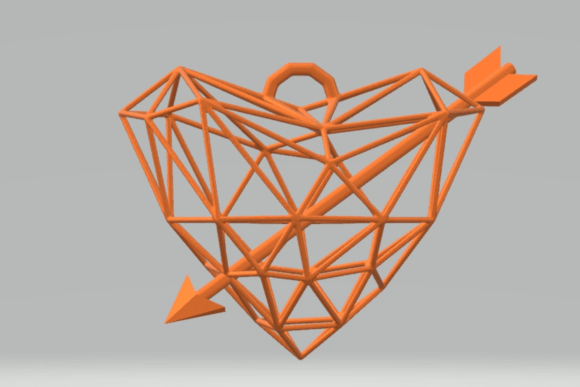
The Faceted Heart with Arrow represents a convergence of geometric aesthetics and additive manufacturing capabilities. Unlike traditional cast jewelry or molded trinkets, this design leverages the specific strengths of layer-based production. Its angular, low-poly appearance is not merely a stylistic choice but a functional adaptation to how modern 3D printers build objects. This uniquely shaped heart pendant is created for 3D printing, optimizing surface area and structural integrity while minimizing the need for support materials. For those navigating the intersection of technology and emotion, this object serves as both a romantic gesture and a testament to contemporary making.
The Shift Toward Digital Craftsmanship
In recent years, we have observed a significant shift in how adults aged 20 to 50 approach consumption and creation. Whether you are an entrepreneur, a freelancer, or a hobbyist, the value proposition of physical goods has changed. We are moving away from passive purchasing toward active participation in the product lifecycle. The Faceted Heart with Arrow fits squarely into this evolving workflow. It transforms the giver from a mere consumer into a curator or manufacturer of their own sentimental artifacts.
This trend extends beyond simple DIY enthusiasm. It reflects a broader desire for customization that factory lines cannot accommodate. When you download the zip file containing 3D printable files in .stl format, you are acquiring potential rather than a finished commodity. This distinction matters. In a professional context, we often discuss "agile" methodologies and iterative design; applying these concepts to personal gifting allows for a level of responsiveness that traditional retail cannot match. You could adjust its dimensions before 3D printing to suit specific preferences, chain lengths, or even to accommodate different printing technologies. This flexibility ensures the final object is tailored to the recipient, not just the occasion.
Material Versatility and Production Choices
One of the most practical advantages of utilizing STL files for jewelry design is material agnosticism. The digital file does not dictate the medium; it only defines the geometry. You could print it however you want, selecting materials that align with your budget, aesthetic goals, and the recipient's lifestyle. This versatility addresses a common pain point in gift selection: balancing quality with accessibility.
- Precious Metals: For those seeking heirloom quality, services exist that allow you to upload STL files for direct metal sintering or lost-wax casting. You could get printed from precious metals like gold, silver, or steel. This elevates the faceted design into fine jewelry, suitable for milestones where permanence is paramount.
- Industrial Plastics: High-performance polymers like nylon or PETG offer durability and a matte finish that complements the geometric nature of the Faceted Heart with Arrow. These materials are lightweight, hypoallergenic, and resistant to wear, making them ideal for daily use.
- Standard PLA and Resin: For rapid prototyping or budget-conscious gifting, standard plastics provide excellent detail resolution. Resin printing, in particular, captures sharp facets without visible layer lines, mimicking the look of cut gemstones at a fraction of the cost.
Understanding these options empowers users to make informed decisions based on real-world constraints rather than marketing hype. A business owner might choose steel for a corporate appreciation gift due to its professional sheen and durability, while a partner might prefer biodegradable PLA for its eco-friendly narrative. The design remains constant, but the execution adapts to the user's specific context.
Design Logic: Why Geometry Matters
The aesthetic of the Faceted Heart with Arrow is deeply rooted in the technical realities of additive manufacturing. Traditional heart shapes often feature smooth, organic curves that require extensive support structures when printed, leading to post-processing headaches and wasted material. By adopting a faceted, low-poly topology, this design aligns with the layer-by-layer construction process. Angles are optimized to prevent sagging, and flat surfaces ensure consistent adhesion.
For educators and makers using this as a teaching tool or a benchmark print, the geometry offers valuable insights into mesh integrity and print orientation. It demonstrates how digital design can solve physical problems. However, for the general user, the benefit is primarily experiential. The sharp lines catch light differently than a smooth curve, creating a dynamic visual effect that changes with movement. This interplay of shadow and highlight gives the pendant a modern, architectural quality that distinguishes it from vintage or classical jewelry styles. It signals an appreciation for contemporary design language, which resonates with tech-forward demographics and creative professionals.
Practical Implications for Creators and Gift-Givers
Adopting 3D printing for personal gifts requires a realistic understanding of the workflow. While the barrier to entry has lowered, successful outcomes depend on preparation. The STL format provided in the zip file is an industry standard, compatible with virtually all slicing software and printing services. However, users should verify their printer’s build volume and tolerance settings before starting.
For those new to the process, consider the following practical recommendations:
- Validate the Mesh: Before sending the file to a service bureau or your own machine, run a quick repair check. While the Faceted Heart with Arrow is designed for printability, transfer errors can occasionally introduce non-manifold edges.
- Consider Post-Processing: If printing in plastic, sanding or vapor smoothing can enhance the faceted look. If ordering in metal, understand that polishing levels vary by vendor. Specify your desired finish to avoid receiving a raw, industrial-looking piece when you intended something refined.
- Scale Appropriately: Jewelry sizing is subjective. Because you can adjust dimensions before printing, create a test print in cheap filament to verify scale against the wearer’s body type. A heart that looks perfect on screen may be too heavy or too small in reality.
- Plan for Lead Time: Custom fabrication takes time. Metal printing services often have queues, and home prints can fail. Factor in buffer days to ensure the gift arrives before Valentine’s Day.
Sustainability and Intentional Consumption
Beyond aesthetics and utility, the choice to 3D print a gift carries environmental implications worth considering. Mass-produced jewelry often involves complex supply chains, significant waste, and opaque labor practices. Localized production via 3D printing reduces transportation emissions and allows for on-demand manufacturing. You produce exactly what is needed, when it is needed.
Furthermore, the ability to repair or reprint fosters a culture of longevity over disposability. If a plastic pendant breaks, it can be replaced instantly using the same digital file. If tastes change, the file can be modified or recycled. This aligns with the values of many modern consumers who prioritize sustainability alongside sentimentality. The Faceted Heart with Arrow is not just an object; it is a node in a more responsible, decentralized production network.
Navigating the Emotional Value of Tech
There is sometimes a hesitation to associate technology with romance. Critics argue that 3D printed gifts feel cold or impersonal compared to handcrafted artisan work. However, this perspective overlooks the intention embedded in digital fabrication. Selecting a specific file, choosing a meaningful material, adjusting dimensions for a loved one, and overseeing the production process requires significant cognitive and emotional investment.
In our current era, where digital interactions often replace physical ones, bringing a digital asset into the physical realm is a powerful act. It makes the intangible tangible. For marketers and bloggers discussing gift trends, this narrative is crucial. We are not selling plastic or metal; we are facilitating a new form of expression that speaks the language of the 21st century. The Faceted Heart with Arrow succeeds because it acknowledges that modern love exists within a technological landscape, and it offers a way to celebrate that reality without sacrificing warmth.
Ultimately, the relevance of this design lies in its adaptability. It serves the professional looking for a sleek accessory, the maker exploring geometric forms, and the partner seeking a symbol that defies convention. By leveraging the precision of STL files and the versatility of additive manufacturing, we move past generic gestures toward creations that are as multifaceted as the relationships they represent. Whether rendered in gold, steel, or sustainable plastic, the result is a testament to the enduring human drive to create, customize, and connect.