Flying Crane Team: Strategic Application of Scalable 3D Wall Decor
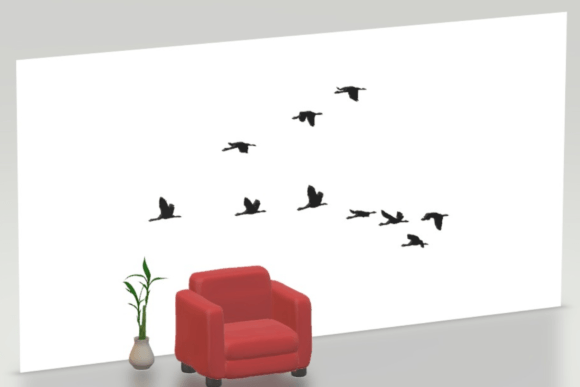
Effective environmental design requires more than aesthetic appreciation; it demands intentionality. The Flying Crane Team represents a shift from static decoration to dynamic spatial planning. As a scalable wall decor system provided as a 3D printable STL file, it offers professionals, educators, and business owners a unique tool for environmental customization. Unlike mass-produced art with fixed dimensions and rigid compositions, this modular system allows you to align physical space with strategic objectives. Whether optimizing a home office for deep work, designing a collaborative studio environment, or creating an immersive backdrop for content creation, the ability to adjust dimensions, color, and bird placement transforms decor into a functional asset.
The strategic value lies in the adaptability of the Flying Crane Team on the Wall. In professional settings, visual environments significantly influence cognitive load, creativity, and brand perception. A fixed piece of art may clash with evolving branding or fail to scale with a new office layout. This 3D printable solution mitigates those risks by placing design control directly in your hands. You are not merely hanging a picture; you are curating an atmosphere that supports specific outcomes, from enhanced focus during planning sessions to improved visual communication in client-facing areas.
Aligning Physical Space with Professional Goals
Before downloading the STL files or firing up your printer, define the objective of the installation. Random decoration adds noise; intentional design adds signal. The Flying Crane Team serves different functions depending on how it is configured. For entrepreneurs and freelancers working in hybrid spaces, the wall decor must often multitask. It needs to look professional on video calls while remaining calming during offline administrative tasks. Because you can modify the number of birds and their spacing, you can create a composition that balances visual interest with negative space, preventing the background from becoming distracting during digital meetings.
For educators and workshop facilitators, the arrangement can serve as a visual metaphor or a focal point for attention. Cranes traditionally symbolize longevity, wisdom, and fidelity. Leveraging these cultural associations through the physical placement of the Flying Crane Team on the Wall can subtly reinforce themes of patience and long-term thinking in learning environments. The scalability ensures that the installation fits precisely within the sightlines of students or participants, maximizing engagement without overwhelming the instructional space. This level of site-specific adaptation is rarely achievable with commercial off-the-shelf decor.
Customization as a Decision-Making Framework
Treating the Flying Crane Team as a customizable system rather than a finished product requires a structured approach to decision-making. When planning your print, consider the following variables as strategic levers:
- Scale and Proportion: Measure your wall space relative to furniture and lighting. A massive, dense flock might energize a large conference room but could induce claustrophobia in a small consulting office. Use the adjustable dimensions to match the visual weight of the room.
- Color Psychology and Branding: Since you can print in any color, align your choice with your desired emotional outcome. Muted earth tones support grounding and stability for financial planners or therapists. Vibrant or high-contrast colors may stimulate creativity for marketing teams or artists. Corporate environments might utilize brand accent colors to reinforce identity subtly.
- Composition and Flow: The placement of individual cranes dictates visual movement. An upward trajectory suggests growth and aspiration, suitable for startups or sales floors. A horizontal spread implies stability and calm, ideal for waiting areas or meditation spaces. Avoid random scattering; treat the wall as a canvas where every bird has a purpose.
- Material and Texture: The STL file allows for material experimentation. Matte PLA reduces glare for video backgrounds, while silk or wood-fill filaments add tactile warmth to client-facing offices. Consider how light interacts with the print at different times of day.
Operational Considerations for 3D Printed Decor
Integrating the Flying Crane Team into your space involves practical operational planning. While the digital flexibility is immense, physical execution requires resource management. Professionals and hobbyists alike must balance the desire for perfection with time and material constraints. Printing dozens of individual components takes time. Batch processing and efficient bed packing are essential to minimize downtime. Furthermore, post-processing requirements vary based on your chosen finish. If you intend to paint the cranes after printing, standard layer lines may be acceptable. If you want a pristine, single-color finish straight from the nozzle, dialing in retraction and cooling settings is critical to avoid artifacts that detract from the professional appearance.
Installation logistics also demand forethought. Because the Flying Crane Team on the Wall is modular, you have the freedom to reconfigure it later. However, frequent changes can damage drywall if not planned correctly. Consider using non-damaging adhesive systems or creating a mounting rail system that allows for easy adjustment without new holes. This foresight preserves the integrity of your physical space and maintains the "scalable" promise of the project. For renters or those in leased commercial spaces, this reversibility is a significant risk mitigation factor.
Risks of Unintentional Implementation
While the Flying Crane Team offers extensive creative freedom, unchecked customization can lead to suboptimal results. One common pitfall is over-cluttering. The ability to print unlimited birds does not mean you should use them all. Visual density competes with cognitive processing. In a workspace designed for analytical thinking, excessive pattern complexity can increase mental fatigue. Always prioritize function over novelty. Test your layout digitally or with paper cutouts before committing to hours of printing.
Another risk involves stylistic dissonance. A highly stylized, low-poly crane might clash with traditional mahogany furniture or classical architecture. Conversely, realistic textures might feel out of place in a minimalist tech hub. Context awareness is paramount. The Flying Crane Team should harmonize with existing elements, not fight them. Additionally, consider the maintenance aspect. Complex 3D prints with many crevices can accumulate dust. In clinical or food-preparation adjacent environments, simpler geometries and sealed finishes are necessary to maintain hygiene standards. Ignoring these practical realities turns a strategic asset into a liability.
Enhancing Communication and Content Creation
For creators, bloggers, and marketers, the background is part of the message. The Flying Crane Team provides a distinctive, ownable visual signature that sets you apart from generic virtual backgrounds or stock posters. By customizing the color palette to match your personal brand guidelines, you create immediate visual consistency across videos, streams, and photos. This reinforces brand recall without verbal explanation. Moreover, because the decor is physical, it interacts naturally with depth of field and lighting, creating a sense of authenticity that digital overlays often lack.
The modularity also supports narrative evolution. As your content strategy shifts, your environment can reflect that change. Launching a series on sustainability? Print the team in recycled PETG or natural green tones. Pivoting to luxury market analysis? Reprint key elements in metallic gold or matte black. This agility allows your physical studio to remain aligned with your digital strategy without major renovation costs. The Flying Crane Team on the Wall becomes a living component of your content infrastructure, adaptable to campaigns, seasons, and audience feedback.
Long-Term Value and Sustainability
Sustainable decision-making extends beyond material choice; it encompasses longevity and adaptability. Fast fashion decor ends up in landfills when trends shift. The Flying Crane Team promotes a circular approach to interior design. Because you own the source files, you can repair, replace, or expand the installation indefinitely. If you move to a larger office, you simply print additional units to fill the new volume. If a piece breaks, you reprint just that segment. This reduces waste and long-term costs compared to replacing entire art pieces.
Furthermore, the skill development associated with fabricating the Flying Crane Team yields compounding returns. Mastering large-scale assembly, color matching, and spatial arrangement enhances your general problem-solving capabilities. These skills transfer to other projects, from prototyping products to organizing events. Viewing this decor project solely as ornamentation misses its potential as a capability-building exercise. For professionals who value continuous learning, the process of realizing the Flying Crane Team on the Wall is as valuable as the final result.
Ultimately, the Flying Crane Team is a tool for environmental agency. It empowers you to reject passive consumption of space in favor of active creation. By approaching this scalable wall decor with strategic intent—considering goals, audience, operations, and long-term viability—you transform a simple STL file into a meaningful intervention in your daily life and work. Whether fostering productivity, enhancing brand identity, or simply creating a sanctuary for thought, the power lies not in the plastic, but in the deliberate decisions guiding its form.