Easter Egg with Bunny and Carrot Inside Design Files
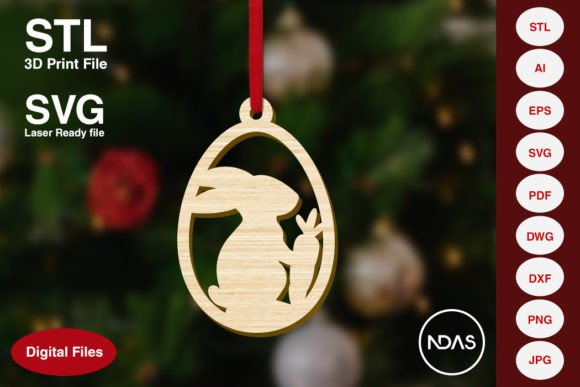
Creating festive decorations often requires balancing intricate design with practical production methods. The Easter Egg with Bunny and Carrot Inside digital template solves this challenge by providing a versatile, pre-designed asset ready for immediate fabrication. Rather than spending hours drawing vectors or modeling geometry from scratch, makers can download this comprehensive file package and begin producing physical ornaments within minutes. This design features a charming silhouette where a bunny and carrot are nestled within an egg outline, offering a classic holiday aesthetic that appeals to both children and adults.
This digital product is specifically engineered for modern fabrication tools. Whether you operate a laser cutter, a vinyl cutting machine like a Cricut or Silhouette, or a 3D printer, the included files ensure compatibility across platforms. The design eliminates the guesswork associated with resizing or converting formats, allowing creators to focus on material selection and assembly rather than software troubleshooting. For small business owners and hobbyists alike, having a reliable, multi-format design streamlines the workflow from digital concept to tangible decor.
Versatile File Formats for Every Fabrication Method
The true value of this Easter decoration ornament lies in its extensive file library. Different machines require specific data types to function correctly, and this package covers the entire spectrum of maker technology. Understanding which file to use ensures the best possible result for your specific project.
- Vector Files (SVG, DXF, EPS, AI): These are essential for laser cutters and CNC routers. SVG and DXF files are universally recognized by software like LightBurn, Glowforge, and VCarve. They allow for infinite scaling without pixelation, ensuring crisp edges whether you are cutting a 3-inch ornament or a large wall hanging. Adobe Illustrator (AI) and EPS files provide professional designers with editable paths for further customization.
- Raster Files (PNG, JPG): High-resolution PNGs with transparent backgrounds are perfect for sublimation printing, heat transfer vinyl, or digital mockups. If you plan to print the design onto cardstock using a standard home printer before hand-cutting, the JPG format offers universal compatibility.
- 3D Print File (STL): The included STL file transforms this 2D concept into a three-dimensional object. Pre-sized at X: 3", Y: 4.5", and Z: 0.25", it provides a solid starting point for FDM or resin printing. This thickness creates a sturdy ornament that feels substantial in hand while remaining lightweight enough to hang on delicate branches.
- Document Files (PDF): Useful for paper crafting, tracing, or educational settings where digital fabrication tools aren't available. PDFs maintain exact dimensions when printed at 100% scale, making them ideal for classroom activities or low-tech prototyping.
Material Compatibility and Creative Applications
One of the most significant advantages of the Easter Egg with Bunny and Carrot Inside design is its material agnosticism. The clean lines and optimized geometry work beautifully across a wide range of substrates, each offering a distinct look and feel.
Wood and Plywood: This is perhaps the most popular choice for laser-cut ornaments. Baltic birch plywood or basswood takes stain and paint exceptionally well. The natural grain adds warmth to the bunny and carrot motif, creating a rustic farmhouse aesthetic. Because the default size is 3 × 4.5 inches, it fits perfectly within standard scrap wood pieces, minimizing waste.
Acrylic and Plastic: For a modern twist, cut this design from colored acrylic or clear plastic with vinyl overlays. Acrylic catches light beautifully, making these ornaments stand out on sunlit Easter trees. The vector files ensure smooth melt-free edges when using appropriate laser settings.
Paper and Cardstock: Not every project requires heavy machinery. Using the SVG or PDF files with a Cricut, Silhouette, or even scissors allows for affordable, batch-produced decorations. Layered cardstock versions can add depth through color blocking, while single-layer cuts serve as elegant gift tags or table place cards.
Metal and MDF: For durable, long-lasting signage or premium ornaments, aluminum or steel sheets can be plasma cut or fiber laser cut using the DXF file. MDF offers a budget-friendly alternative to solid wood with a perfectly uniform surface for painting, though it requires proper ventilation during cutting.
Scaling and Customization Best Practices
While the design comes with recommended dimensions—3 × 4.5 inches for 2D applications and an additional 0.25-inch depth for 3D prints—it is fully scalable. However, resizing requires some technical consideration to maintain structural integrity.
When scaling down for miniature uses, such as jewelry charms or cake toppers, check the thinnest points of the bunny ears and carrot leaves. Vector files can be scaled infinitely, but physical materials have limits. If cutting from wood below 2mm thick, avoid reducing the design below 2 inches tall to prevent breakage. Conversely, when enlarging the design for yard art or window displays, consider adding internal support bridges or increasing the stroke width to maintain rigidity.
For 3D printing, scaling affects print time and material usage proportionally. Increasing the Z-height beyond 0.25 inches can create a more robust ornament suitable for outdoor display, while reducing it creates a delicate, lace-like effect. Always verify bed adhesion and layer height settings when deviating from the base STL dimensions.
Practical Considerations Before You Start
To get the most out of this digital asset, keep a few practical tips in mind. First, remember that no physical items are contained in this purchase. You are acquiring the intellectual property and digital blueprints necessary to create the item yourself. Ensure you have access to the required hardware or a local maker space before purchasing.
Second, always perform a test cut or print. Material batches vary in density and thickness, especially with natural products like wood and cardboard. A quick test using the PNG or a small section of the SVG helps dial in speed and power settings without wasting valuable material. For laser users, masking tape can protect lighter woods from scorch marks around the intricate bunny details.
Finally, consider your finishing process during the design phase. If you plan to paint the ornament, cutting from raw wood or MDF is ideal. If you prefer a natural look, select a plywood with an attractive face veneer. For 3D prints, decide whether you want visible layer lines as part of the texture or if you will sand and prime the surface. The versatility of the Easter Egg with Bunny and Carrot Inside files supports all these outcomes, empowering you to create professional-quality Easter decorations tailored exactly to your vision.